About CRYSTAL Conveyor Belt Roof Cover System
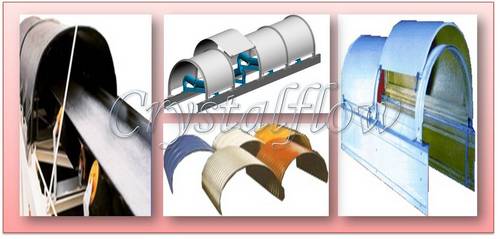
We are one of the prominent company engaged in providing an excellent quality Conveyor Belt Roof Cover System. This system is manufactured by making use quality assured raw materials in accordance with the international quality norms as per set international quality norms. Provided system is fitted at the top of conveyor system. Apart from this, offered Conveyor Belt Roof Cover System can be availed from us at reasonable price range
Features:
-
Perfect finish
-
Sturdy construction
-
Low maintenance
Conveyor Belt Roof Cover System
- Test Certificates: Density/Module/Tensile From Cipet.
- Usage: Suitable for Chemical Processing Plants, Fertilizer Plants, Food Industry, Pharmaceutical Industry, Salt Water Ports & Docks and Sugar Industry.
- Available Sizes: Customizable
- Manufactured & Dispatchable Qty. /Day: 1 To 5 Nos. If Requirement Arises.
Benefits
- Long life, durable, less weight and resistance to weather and erosion
- Self supported Curve shaped
- Frame construction is not needed
- Installation / erection is possible on each side of mild steel angles or channels
- U.V Stabilized
- Keeps the area UN polluted, ensuring uniformity of the product which travels via conveyer
- Belt is hygienic and virus free
Precision-Engineered ProtectionCRYSTAL Conveyor Belt Roof Cover Systems utilize state-of-the-art roll forming technology to create custom-fit solutions. These covers are designed to defend industrial conveyor belts against environmental hazards, enhancing longevity and performance.
Superior Materials and CoatingsCrafted from galvanized steel or stainless steel, the roof covers benefit from reliable corrosion resistance. Surface treatments in polyester, epoxy powder, or zinc coatings further reinforce their durability, supporting long-term use in demanding environments.
Versatile Application and CustomizationThe cover system is customizable for various conveyor belt sizes, making it ideal for a wide range of industrial sectors across India. Options can be tailored for differing dimensions, ensuring the perfect fit and optimal protection for each application.
FAQs of CRYSTAL Conveyor Belt Roof Cover System:
Q: How does the CRYSTAL Conveyor Belt Roof Cover System protect industrial conveyor belts?
A: The system forms a robust barrier over conveyor belts, shielding them from weather extremes, dust infiltration, and material spillage. This protection minimizes downtime and maintains cleaner, more efficient operations.
Q: What materials are used in manufacturing these roof covers?
A: The covers are made from premium galvanized steel or stainless steel and are treated with galvanized, polyester, epoxy powder, or zinc coatings for enhanced longevity and corrosion resistance.
Q: When should industrial facilities consider installing conveyor belt roof covers?
A: Facility managers should install roof covers whenever conveyor belts operate outdoors or in environments exposed to dust, moisture, or risk of spillage. Early installation ensures optimal equipment protection and operational efficiency.
Q: Where can the CRYSTAL Conveyor Belt Roof Cover System be used?
A: These roof covers are suitable for all industrial sectors, particularly where conveyor belts require continuous protection. They are widely employed in manufacturing plants, mining operations, and processing facilities throughout India.
Q: What is the process for customizing the cover to a specific conveyor size?
A: Once the conveyor dimensions are provided, precision roll forming is used to create covers tailored to those specifications. Custom coatings and materials are selected based on the operating environment and facility requirements.
Q: How does the surface treatment benefit the systems performance?
A: Surface treatments like powder coating or zinc plating greatly enhance the covers resistance to corrosion, abrasive conditions, and harsh weather, ensuring a longer service life and minimal maintenance.
Q: What are the primary benefits of installing this roof cover system?
A: Key advantages include protection from environmental damage, improved workplace safety, reduced belt maintenance, and compliance with environmental standards, contributing to overall operational reliability.






 English
 Spanish
 French
 German
 Italian
 Chinese (Simplified)
 Japanese
 Korean
 Arabic
 Portuguese
 Send Inquiry
 Get Latest Price

